

MES vs IIoT: What additional value does IIoT bring?
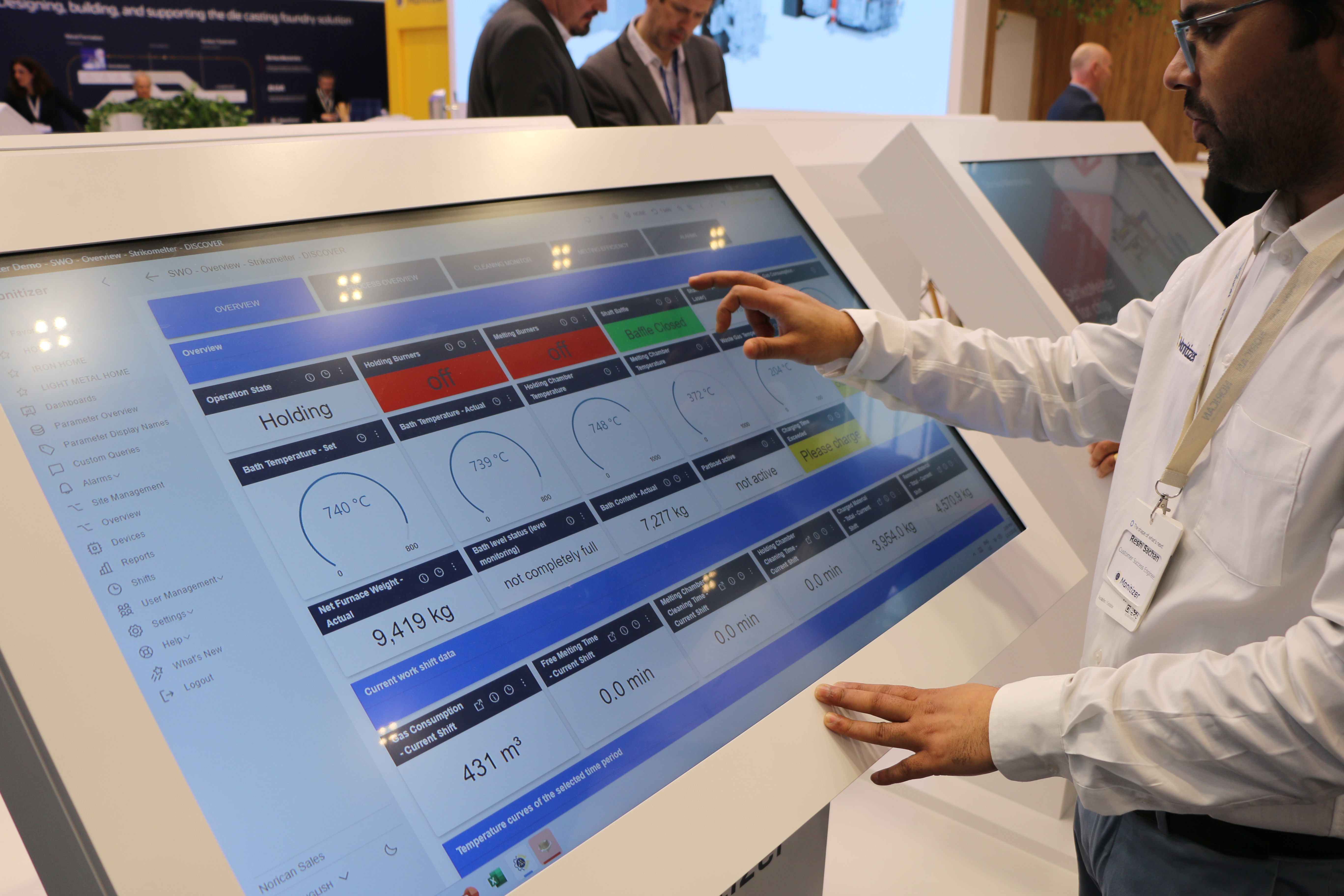
Technology powers today’s manufacturing. Deploying the right systems is vital.
Even if you already have a Manufacturing Execution System (MES) in your foundry, adding a cloud-hosted Industrial Internet of Things (IIoT) platform opens the door to infinitely greater insight.
MES systems are designed to enforce predefined processes and are often rigid and IT‑centric. When manufacturers need to adapt quickly or drive continuous improvement, this can become a bottleneck. Compared to MES platforms, an IIoT solution like Monitizer adds much more flexibility. It can deliver real-time information to engineers and operators, feed many types of analytics and reduce reliance on IT specialists for improvement initiatives.
With IIoT, you can collect live, high-frequency process data, choose the most appropriate analytics, then apply the insight to cut scrap, energy consumption, maintenance downtime, and overall cost per casting. In practice, this enables you to:
- Build a single process database
- Remote, real-time monitoring of your entire process
- Cloud-connected for global, multi-site cover
- More effective root cause analysis
- Feed AI-driven predictive analytics for real-time process optimization
What is an MES?
A MES manages, monitors and controls production processes on the foundry floor. Its core job is execution and control: what is being produced, where it is in the process, which batch or order it belongs to, and when it moves next.
A typical MES supports applications like production scheduling, work order management, quality control, traceability and performance monitoring.
In a foundry, an MES might track which batch of castings was produced on which machine, and when, and record quality results for each batch.
- MES platforms are systems of record for the shop floor
- Structured data to enforce production workflows
- Centralized, software-driven architecture (server/cloud)
What is IIoT?
IIoT refers to interconnected physical sensors, devices and other data sources, networked together with industrial software applications. This connectivity enables real-time, automated collection and analysis of very high-resolution data.
The Monitizer IIoT solution automatically populates a single, cloud-hosted process database and generates KPIs using this precise data, while storing the data for future use. The insight from this database supports many applications such as predictive/prescriptive maintenance and forms the foundation for advanced AI-driven process optimization, such as with the Monitizer | PRESCRIBE solution, which is proven to reduce scrap by 40% or more in foundries.
- Increase intelligence and insight into operations
- Make better decisions and track outcomes
- Drive higher efficiency, lower scrap and higher OEE
- Eliminate manual data entry
- Enable real-time monitoring and alerting,
- Provides data and tools for detailed analysis to find true root causes of low casting quality, machine downtime, low OEE
- Supports applications like predictive/prescriptive maintenance
- Decentralized architecture (edge devices feed IIoT platform)
How MES and IIoT combine to drive smarter operations
Why pick a cloud-based solution?
Modern cloud APIs make integrating IIoT with other systems much quicker and easier. As well as simplifying integration, there are many other reasons to choose a cloud-based system over an on-premise alternative for viewing, storing, analyzing and sharing your production data.
- Enterprise-grade security
- Scalability and flexibility
- Predictable budgeting
- Minimal administration
- Collaboration anywhere
Click here for more information on why cloud-based platforms like Monitizer are the best way to improve industrial performance.
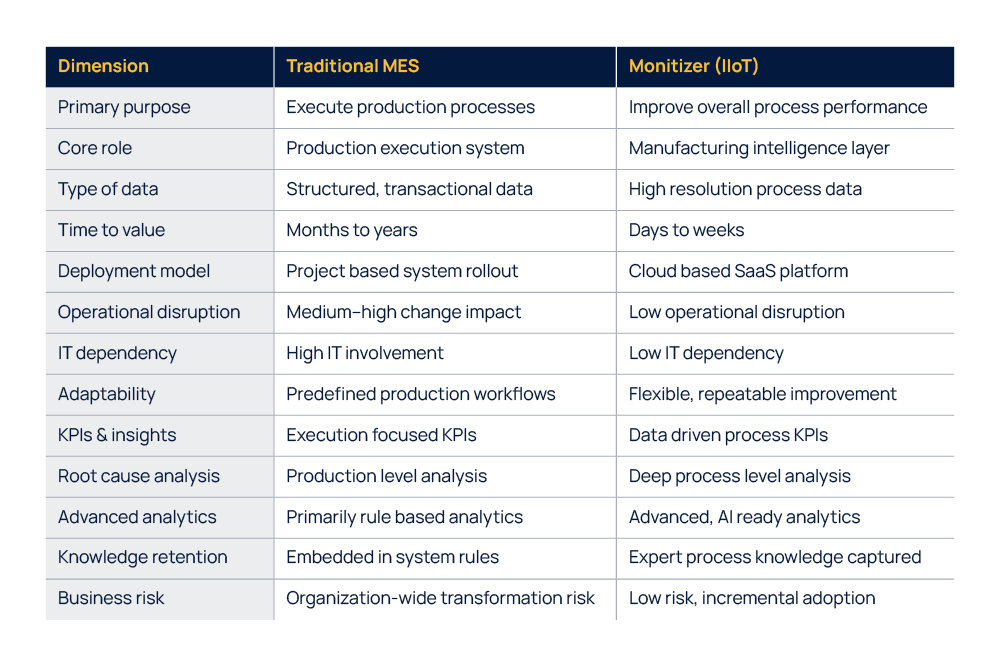

Why IIoT is the perfect addition to an MES
An MES is like the control panel on a treadmill – it tells you speed, incline, and makes sure you don’ tfall off.It’s very good at real‑time control. But it’s the wrong tool to analyze long‑term cardiovascular health trends. For that, you need a different system that collects raw data over time and gets smarter with usage...
By integrating the two systems, value flows in both directions. MES data provides structure and process context, while IIoT adds analytical depth and continuous learning over time. Insights from IIoT - such as emerging out-of-spec behaviour or degradation trends - can then be fed back into MES-driven workflows, triggering maintenance actions or quality interventions, explains Yunus Akyürek, Monitizer Senior Product Manager